

For UK care providers and healthcare organisations, this is where contingent workforce management differs from traditional healthcare staffing software.
Rather than simply recording staffing activity and reporting on spend afterwards, a well-designed contingent workforce process helps organisations prioritise their own people first, bring external support into the process only when it is needed and give Finance and Operations visibility before costs are committed.
The key question is not simply: “Can we find cover?”
It is: “Can we control the journey from an open shift to an external cost?”
Rotagap is built around that principle: give your own team the first opportunity to cover a gap, keep the process controlled and make external spend visible earlier.
What is contingent workforce management in healthcare?
Contingent workforce management is the process of controlling how an organisation uses internal staff, bank workers and external staffing support when additional cover is required.
Instead of treating every rota gap as a separate last-minute problem, the organisation creates a clear process for how that gap should be offered, escalated and approved.
For care groups and healthcare organisations, that can mean:
- Offering available shifts to your own trusted team first
- Giving bank workers the opportunity to provide cover
- Only approaching approved external suppliers when internal options have been exhausted
- Controlling which suppliers are approached first
- Keeping Finance and Operations aware of spend as it happens
- Measuring savings against an agreed baseline
With Rotagap’s smart internal-first cascade, open shifts can follow the route your organisation chooses, beginning with your own people before moving to external support where required.
The important distinction is simple: external cover becomes part of a controlled process rather than the automatic first response to a gap.

What is the difference between staffing visibility and staffing control?
Reporting dashboards are useful. They can help Finance understand agency usage, staffing trends, fill rates and supplier spend.
But the biggest opportunity to manage cost comes before external cover has been confirmed.
That means giving managers a clear route for covering a gap, prioritising internal availability and creating appropriate controls before spend is committed.
How is Rotagap different from traditional healthcare staffing platforms?
The UK healthcare workforce technology market includes platforms supporting staff banks, temporary staffing, workforce planning, rota management, agency management and external worker marketplaces.
Different platforms solve different parts of that challenge.
Rotagap focuses on what happens after a gap appears and before external spend is committed.
It works alongside your existing rota rather than asking you to replace it, giving organisations a structured route for dealing with gaps once they appear.
Your own people can be offered the opportunity first. If cover cannot be found internally, the gap can move through your approved external support in the order that works for your organisation.
Why does controlling agency spend earlier matter?
Once an expensive external shift has already been confirmed, Finance has limited ability to change the decision.
The opportunity to reduce that cost exists further upstream.
That is why an effective workforce strategy should focus on the point where the gap first appears and the decisions made immediately afterwards.
Nearly £1 billion reduction in NHS agency spend
In June 2025, the UK Government reported that NHS spending on agency staff had fallen by almost £1 billion during 2024/25 following measures aimed at tightening control of agency expenditure.
The wider lesson applies beyond the NHS: the earlier an organisation can see and influence the route to external cover, the greater the opportunity to manage unnecessary cost.

The finance test: can you control spend before it happens?
If you are assessing temporary staffing technology, there are four useful questions to ask:
These questions move the conversation beyond dashboards and towards practical workforce governance.
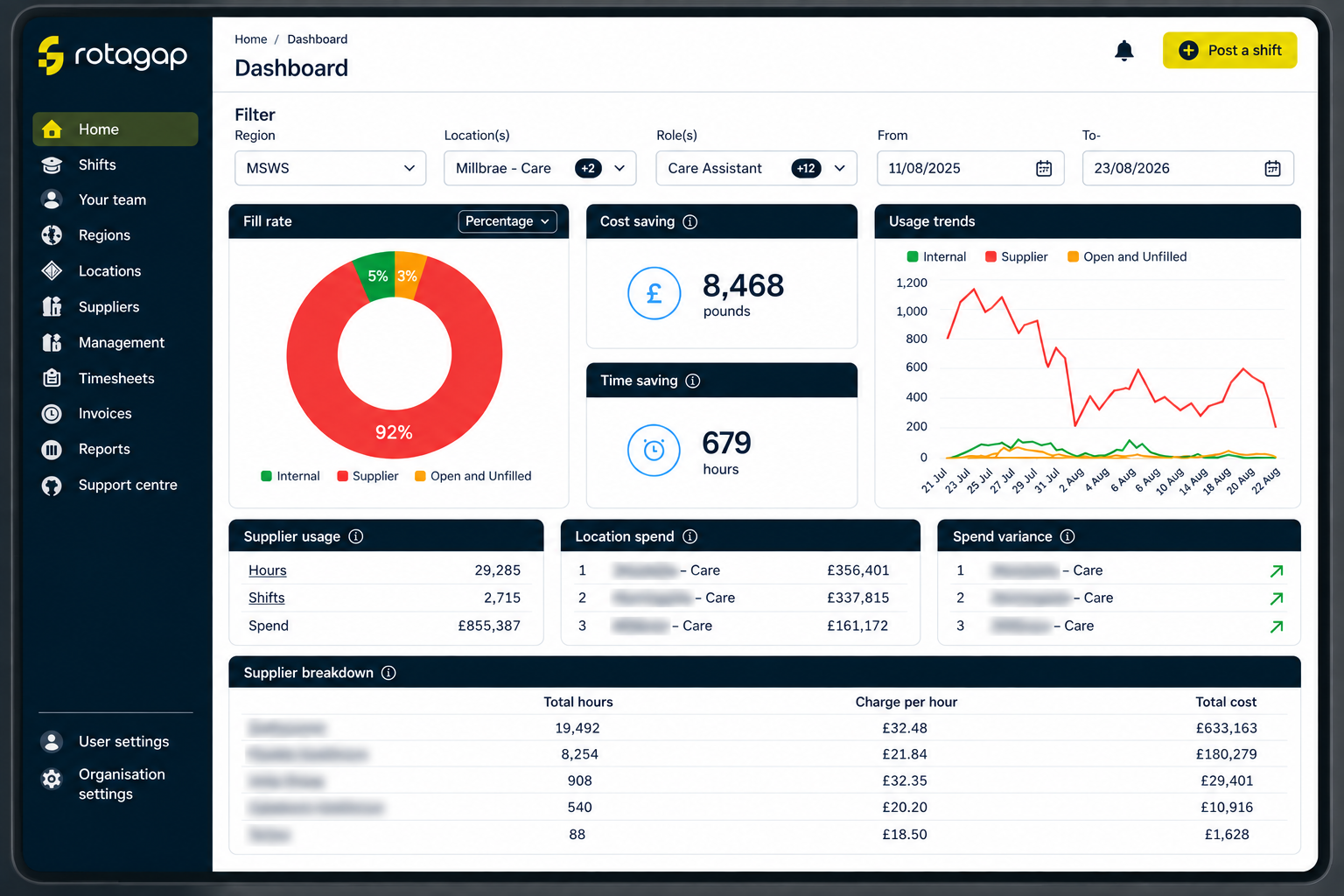
Through Rotagap, Operations and Finance can gain greater visibility of staffing activity, spend and the decisions creating that spend.
Why can an internal-first approach reduce reliance on agencies?
Access to more external suppliers can improve your chances of finding cover. But it does not necessarily address the reason external support was needed in the first place.
An internal-first approach changes the order of the process.
Rotagap helps organisations offer available shifts to their own trusted people before moving to external support. If the shift still needs external cover, approved suppliers can then be approached according to the organisation’s preferred route.
This gives internal teams a better opportunity to pick up available work while helping organisations reduce unnecessary reliance on higher-cost external cover.
Does Rotagap require staff to download an app?
No. Staff can receive opportunities through familiar channels such as email and SMS without needing to download another app.
This matters because workforce technology only works when people actually use it. Keeping the experience straightforward makes it easier for your trusted team to respond while managers retain visibility of the process.
Compliance, timesheets and invoicing in one place
External staffing creates more than a scheduling challenge. Compliance information, approved hours, timesheets and supplier charges all need to remain connected to the person and shift involved.
Rotagap brings these parts of the process together.
Compliance information associated with external workers can be viewed as part of the approval process, helping managers understand whether the required documentation is in place before confirming cover.
Timesheet information can then follow the shift through the workflow, giving Operations and Finance a clearer record of hours worked and costs incurred.
Is Rotagap suitable for multi-site care groups?
Yes. Multi-site organisations are exactly where having one consistent process becomes particularly valuable.
Without a shared system, different homes or services can develop their own ways of responding to rota gaps. One manager may contact internal staff first. Another may immediately call an external supplier. Another may work through WhatsApp messages, spreadsheets and phone calls.
The result can be inconsistent supplier usage, limited oversight and month-end costs that are difficult for Finance to anticipate.
Rotagap provides a shared route for dealing with gaps across the organisation, creating one platform and one process connecting Operations, Finance, HR and leadership.
What should healthcare organisations look for in contingent workforce software?
The strongest workforce platform is not necessarily the one with the most features. It is the one that improves the decisions made when a staffing gap appears.
Look for technology that helps you:
- Prioritise internal cover
- Reduce unnecessary external staffing costs
- Control how and when approved suppliers are approached
- Give managers a simple and consistent process
- Provide Finance with earlier visibility of potential costs
- Maintain appropriate compliance information
- Connect shifts, timesheets and costs
- Measure whether the platform is delivering genuine savings
That is the difference between technology that simply records workforce activity and technology that helps you manage it.
The commercial test: does the platform actually save money?
Workforce technology has to justify its place on the P&L.
More dashboards and more data are not enough if they do not translate into better decisions and measurable financial improvement.
Rotagap’s commercial principle is straightforward:
The saving generated should exceed the cost of the platform.
No saving. No fee.
Frequently asked questions about contingent workforce management
What is contingent workforce management in healthcare?
Contingent workforce management is the process used to manage additional workforce requirements outside an organisation’s core contracted staffing. In healthcare, this can include internal staff, bank workers and approved external staffing providers.
How can care homes reduce agency spend?
One approach is to give internal staff and bank workers the opportunity to cover available shifts before approaching external suppliers. Organisations can also improve supplier controls, increase visibility of staffing costs and measure agency usage across locations.
What is an internal-first staffing model?
An internal-first staffing model offers available work to an organisation’s own trusted workforce before moving to external support. The aim is to make better use of existing capacity before incurring additional external costs.
Can Rotagap work alongside an existing rota system?
Yes. Rotagap is designed to work alongside an organisation’s existing rota process, providing a structured way to manage gaps rather than requiring the whole rota system to be replaced.
Is Rotagap suitable for multi-site care groups?
Rotagap is designed for organisations that need greater consistency and visibility when managing staffing gaps across one or multiple locations, including multi-site care groups.
How does Rotagap help Finance teams?
Rotagap gives Finance greater visibility of external staffing activity and the decisions that lead to external spend, helping organisations understand costs earlier and measure savings against an agreed baseline.
See Rotagap in action
What if you could see and control agency spend before it happens?
See how Rotagap can help your organisation prioritise internal cover, manage external support and gain greater control over staffing costs.
